20% off £40 or 15% off £30
 Track an order
 Buy It Again
 Favourites
 Manage account
 Rewards
 Subscriptions
 Find a store
 Help centre
Chamomile oil benefits – what does the science say?
Written byNatalie Beastall

Reviewed byMarion Mackonochie, BSc (Hons), MSc, MCPP
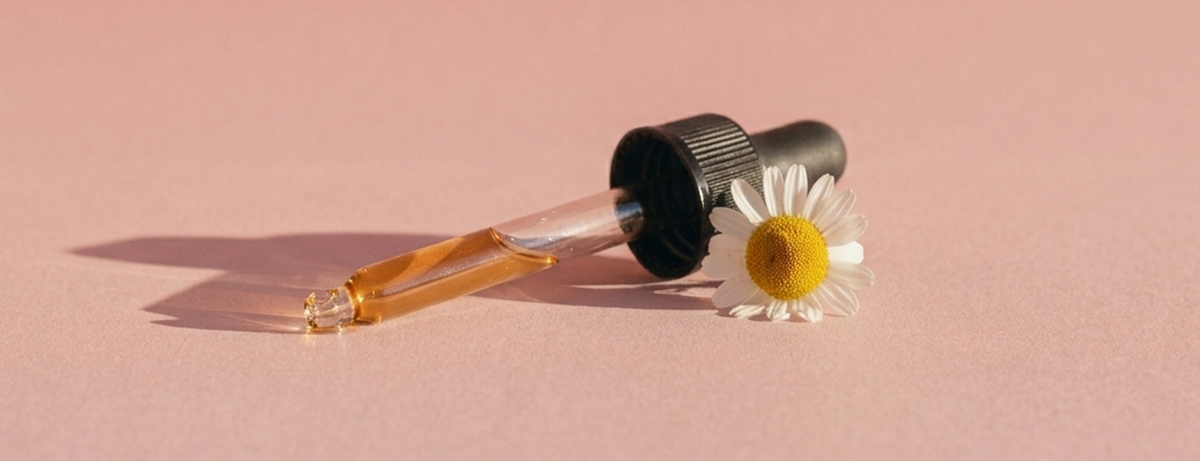
Think chamomile is just for bedtime tea? From its surprising blue hue to research into sleep, skin and even the brain, there’s much more to this little flower than meets the eye
Summary
1What is chamomile oil?
Chamomile oil is the concentrated essential oil extracted from chamomile flowers but in a more potent form.
2Chamomile oil benefits
Benefits being studied are how chamomile oil can affect sleep, relaxation and more.
3How to use chamomile essential oil
There are many ways you can use it, including as a massage oil, a freshener spray, in the bath or in a diffuser.
You’ve probably spotted the little flower floating around in bedtime teas and wind-down blends, but there’s another side to this soothing staple – and it’s a lot more interesting than you might expect.
For starters, some chamomile essential oil is blue which comes from German chamomile.1 That dainty white-and-yellow flower can produce a strikingly coloured oil that’s found its way into everything from aromatherapy to skincare. And now scientists are investigating it for some surprising reasons, too, from sleep and relaxation to discomfort and skin. Let's look at how much of chamomile’s calming reputation stands up to scrutiny.
What is chamomile oil?
Chamomile oil is the concentrated essential oil extracted from chamomile flowers – essentially, the familiar little flower in a much more potent form.2 It’s usually made using steam distillation and can come from different species of chamomile, most commonly German chamomile.3 Despite coming from a rather unassuming flower, the finished oil is anything but ordinary.
What are some chamomile oil benefits?
Chamomile’s relaxing reputation goes back centuries – but what happens when you put some of those age-old claims under the scientific microscope? While research into chamomile essential oil is still developing, studies have started to explore everything from sleep and stress to skin and pain. Here’s what we know so far.
It might help you wind down
There could be something behind chamomile’s sleepy-time reputation. In a recent randomised controlled trial, 80 young adults with insomnia either inhaled chamomile oil for 10 minutes a day for 15 days or continued with their usual routine.4 Those using chamomile oil reported improvements in sleep quality.
Promising? Yes. Proof that a sniff of chamomile will send everyone straight to sleep? Not quite. It was one relatively small study, so we need more high-quality research to understand how useful chamomile oil might really be good for sleep.
It's been studied in relation to relaxation
In one randomised controlled trial involving 183 older adults, participants inhaled either chamomile essential oil, lavender essential oil or distilled water for 30 nights. Both essential-oil groups reported improvements in helping with everyday stress and sense of calm compared with the control group.5
Other clinical research has explored chamomile aromatherapy in hospital settings, too. A 2026 review of 17 studies found promising results in feelings of discomfort and a sense of calm, although the researchers noted that more robust research is still needed.6 So, think interesting evidence, rather than a replacement for established treatments.
Chamomile oil and skincare preparations
If your skin’s feeling a little less than happy, chamomile might sound like an appealing addition to your bathroom shelf. In a 2025 lab study comparing German and Roman chamomile essential oils, both showed antioxidant and soothing activity.7 Antioxidants are studied for their ability to help protect skin against oxidative stress – one of the processes involved in skin ageing.8
This could help explain why chamomile continues to pop up in skincare formulas, but there’s an important catch: these weren’t clinical trials testing chamomile oil on people’s skin.9 So, while the early science gives researchers plenty to explore, we can’t yet say chamomile essential oil will calm redness, tackle blemishes or treat inflammatory skin conditions.
It’s being investigated for feelings of discomfort
Here’s one you might not expect: researchers have also looked at chamomile oil in relation to discomfort. In a randomised, double-blind clinical trial involving 128 women following caesarean sections, inhaling 5% chamomile oil was associated with lower discomfort scores compared with placebo.10 And it’s not the only study to show promising results – research in other hospital settings has also linked chamomile aromatherapy with lower reported discomfort scores overall.11
How to use chamomile essential oil
Ready to give chamomile oil a go? Whether you’re winding down before bed or adding a little aromatherapy to your day, there are a few easy ways to use it.
- Diffuse it: probably the simplest place to start. Add the recommended number of drops to your diffuser, follow its instructions and let the aroma fill the room. Try it while you’re reading, relaxing on the sofa or getting ready for bed
- Massage: turn your usual massage into an aromatherapy moment by diluting chamomile essential oil in a carrier oil before applying it to your skin. Essential oils are highly concentrated, so they shouldn’t be applied neat, you should always follow the instructions and carry out a patch test before use
- Try it in the bath: a warm bath + chamomile sounds like a pretty dreamy combination. Just don’t drip essential oil directly into the water as oil and water don’t mix, so this can leave concentrated droplets sitting on your skin. Instead, use a suitable bath base and follow the instructions for your particular oil
Chamomile oil FAQs
Chamomile essential oil is most commonly used in aromatherapy, but it also appears in skincare and body care. Research is exploring chamomile oil in areas including sleep, anxiety, skin and discomfort, but many of these potential benefits are still being studied rather than firmly established.
You can use chamomile oil as part of your bedtime routine, and there’s some early research behind the idea. However, there isn’t enough to say chamomile oil will improve everyone’s sleep.
If you’re using pure chamomile essential oil, don’t apply it directly to your skin. Essential oils are highly concentrated and should be properly diluted in a carrier oil or used in a ready-formulated skincare product, following the product instructions.
The final say
Chamomile may be an old-school botanical, but the science surrounding it is still surprisingly young which means there's still plenty of questions left to answer. For now, think of chamomile essential oil as something to enjoy rather than a cure-all. Add its aroma to your wind-down routine, use it safely and properly diluted where appropriate – and keep an eye on the research. This centuries-old flower might still have a few surprises left.
Looking for more ingredient-led information? Take a look at how to use rosehip oil on your face and body or your complete guide to passionflower.
Disclaimer – This article provides informational advice and is not a substitute for medical care. Working with experts for accuracy, we take great care to ensure the information is up-to-date and relevant. However, you should always consult your GP or healthcare professional before using supplements or alternative products, particularly if you have medical conditions or are under supervision.
Pure essential oils should never be applied directly and undiluted to the scalp/skin or bath as it can lead to irritation, burns and skin damage. Please dilute properly, read warnings and follow instructions provided on the product label carefully before use.
1. Petronilho S, Maraschin M, Coimbra MA, Rocha SM. In vitro and in vivo studies of natural products: A challenge for their valuation. The case study of chamomile (Matricaria recutita L.). Industrial Crops and Products [Internet]. 2012 Nov 1 [cited 2026 Aug 18];40:1–12. Available from: https://www.sciencedirect.com/science/article/abs/pii/S0926669012001343
2. Chamomile - an overview | ScienceDirect Topics [Internet]. www.sciencedirect.com. [cited 2026 Aug 18]. Available from: https://www.sciencedirect.com/topics/pharmacology-toxicology-and-pharmaceutical-science/chamomile
3. Sah A, Naseef PP, Kuruniyan MS, Jain GK, Zakir F, Aggarwal G. A Comprehensive Study of Therapeutic Applications of Chamomile. Pharmaceuticals [Internet]. 2022 Oct 1 [cited 2026 Aug 17];15(10):1284. Available from: https://www.mdpi.com/1424-8247/15/10/1284/htm
4. Y. Deepa, Vijay A, L. Nivethitha, G. Nandhakumar, S. Sathiya, A. Mooventhan. Effects of chamomile oil inhalation on sleep quality in young adults with insomnia: A randomized controlled trial. The International Journal of Psychiatry in Medicine. 2024 Nov 15;.
5. Ebrahimi H, Mardani A, Basirinezhad MH, Hamidzadeh A, Eskandari F. The effects of Lavender and Chamomile essential oil inhalation aromatherapy on depression, anxiety and stress in older community-dwelling people: A randomized controlled trial. EXPLORE. 2021 Jan;18(3).
6. Anxiety and Complementary Health Approaches [Internet]. NCCIH. NCCIH; 2022 [cited 2026 Aug 18]. Available from: https://www.nccih.nih.gov/health/anxiety-and-complementary-health-approaches
7. Batovska D, Natalina Panova, Anelia Gerasimova, Yulian Tumbarski, Ivanov I, Ivayla Dincheva, et al. Chamomile Matters: Species- and Producer-Dependent Variation in Bulgarian Matricaria recutita L. and Chamaemelum nobile L. Essential Oils and Their Cosmetic Potential. Cosmetics [Internet]. 2025 June 13 [cited 2026 Aug 18];12(3):123–3. Available from: https://www.mdpi.com/2079-9284/12/3/123
8. Papaccio F, D′Arino A, Caputo S, Bellei B. Focus on the Contribution of Oxidative Stress in Skin Aging. Antioxidants. 2022 June 6;11(6):1121.
9. Chen G, Lv C, Nie Q, Li X, Lv Y, Liao G, et al. Essential Oil of Matricaria chamomilla Alleviate Psoriatic-Like Skin Inflammation by Inhibiting PI3K/Akt/mTOR and p38MAPK Signaling Pathway. Clinical, cosmetic and investigational dermatology [Internet]. 2024 Aug [cited 2026 Aug 18];17:59–77. Available from: https://pubmed.ncbi.nlm.nih.gov/38222858/
10. Zardosht R, Basiri A, Sahebkar A, Emami SA. Effect of Chamomile Oil on Cesarean Section Pain in Primiparous Women: A Randomized Clinical Trial. Current Reviews in Clinical and Experimental Pharmacology [Internet]. 2021 Nov [cited 2026 Aug 18];16(4):369–74. Available from: https://www.eurekaselect.com/article/105566
11. Cabral MAL, Dutra SVO, Leal KC da S, Rojas YLG, Miranda ABS de A, Santos CF dos, et al. Effect of chamomile aromatherapy on pain and anxiety management in hospital settings: A scoping review. Complementary Therapies in Medicine [Internet]. 2026 Aug [cited 2026 Aug 18];99:103384. Available from: https://www.sciencedirect.com/science/article/pii/S0965229926000671
Related to this article


